Sunday, February 16, 2014

Tata, Hungary, where we said ta-ta to Hungary.


After we left the monastery, Judit, Lilly, Adrienne and I headed to the town of Tata, where they had a castle and a cafe.

We stopped first at a confectionery for a taste of cake and something to drink.

The cafe's building was quite yellow.
The town is quite cute.
 Here's the confectionery where we ate.
After our snack, we headed over to the castle. The land with the castle was originally placed on a Roman settlement, then the castle was built on the same land. The castle museum had a lot of the Roman ruins, as well as the newer castle.

The castle was built in the Renaissance style. I'm not sure exactly when, but the first mention of the town was in 1221, so it was built sometime after that.

The castle was built along a fairly large lake, which is quite beautiful.
And here's the castle. During the Ottoman Empire, the castle was an important fortress. It was captured in 1529, then later burned down by the Habsburgs. The Esterhazy family, mentioned in the previous blog because they owned parts of the monastery, later bought the property and built a mansion/palace nearby for them to live in.


Here's the side of the castle.


Among the artifacts are altar stones and Roman sarcophaguses and other carvings in the yard of the Castle.


This is a Roman carving with various gods standing under each arch.


They had old Roman statues as well, which were really cool.

And extremely tiny. But also really cool.


There's a scary baby head (Adrienne).


Here's an old furnace.


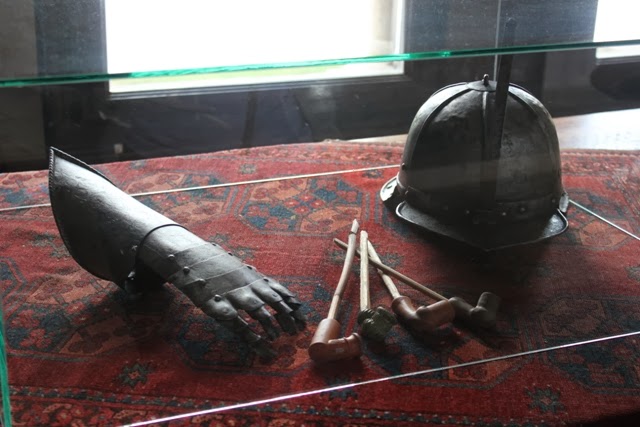
A helmet. For some reason it is accompanied by pipes. The reasoning is unclear.
In addition to Roman ruins, the museum housed a variety of traditional Hungarian pottery and paintings.
They also had an interesting clock.

This was beautiful.
A man casually leaning on his teacup.

This was also beautiful.
As was this. Everything was intricately designed.
Here's some lettuce.

The view from the castle, overlooking some of the Roman ruins that are just hanging out in the garden.
There's the town from above.
There were children playing among the ruins.

There's Adrienne in front of the castle.


If you want any more information about the castle, the museum's website is here.


After exploring the castle, we headed towards the Esterhazy palace and walked on the lake.


The castle from the back.
This is the Esterhazy mansion/palace. It's not quite a palace but is a very large mansion.


We continued walking along the lake, passing this horse statue, then looking at the water.

We watched a dragon boat practice for a bit.

Looked at the castle from the lake.

Took some pictures, then headed back to the car.


The outside walls of the castle were pretty beautiful.

We headed back to Budapest afterwards. Nora came over that evening and we all chatted and ate dinner, until heading to bed. It was a nice last day in Hungary! Adrienne and I headed to Vienna the next day, feeling quite sad about leaving. Judit, Kosztya, Nora and Lilly are so welcoming and wonderful. I hope to make it back to visit as soon as I can!


Saturday, February 8, 2014

Majk, Hungary, where the silence is deafening

The morning after the Clouds headed home, Judit, Lilly, Adrienne and I headed out of Budapest to see some lesser known locations. Our first stop was the small town of Majk, which is home to a Camaldolese Monastery.

We got a bit lost on the way, drove down a dirt road that was not correct, but eventually asked for directions and figured out where we were going.

We arrived at the Camaldolese Monastery that we were looking for. It had a very interesting history. It was established in 1733, but was active only until 1782, when Emperor Joseph II ordered that any monastery be dissolved if it wasn't serving any purpose. He ordered the closing of most religious houses in Hungary.

In the Camaldolese order, the monks lived in complete silence, except for 3 days at Christmas and 3 days at Easter.

This meant that they lived in separate houses, away from other people. They were required to pray and read the Bible for 8 hours a day, but otherwise they would do crafts, art or play solitary games for the rest of the day.

They live in complete isolation. People would deliver them food by placing it in a turning tray, which the monks would turn around when they knew the person had left. If they were sick, they would put a candle in a window and someone would come to take them to the hospital. They were served by laymen from the village, some who wished to be members of the order but were not able to join.

They were probably not able to join because it would be absolute torture.

But that's just my opinion.

Each cottage had its own private chapel and a walled garden.

It is no longer an active monastery, due to Joseph II, but there continues to be a working Camaldolese Monastery in Poland, which recently allowed photographers for the first time.

After it was a monastery, it was the home to the Eszterhazy family and then nationalized by the communists in the 1950s.
Each of the houses has a coat of arms, which are the tributes to the noble families that financed the construction of each house.


These are the remains of the church. The foundation was laid in 1753, but the interior was not built until 1764. According to a sign outside the church, Prince Ferenc Rakoczi, the Hungarian patriot, lived in exile in a Camaldolese monastery in Grobois, France. When he died in 1735 in Turkey, he asked that his heart be removed from his body and sent to be buried in Grobois. The sign said, "The soul of the prince found solace within the lonesome walls of the monastery after his lifelong duel with fate." The Grobois monastery was destroyed during WWII, including his heart.


I loved all the lavender that was planted throughout the grounds.

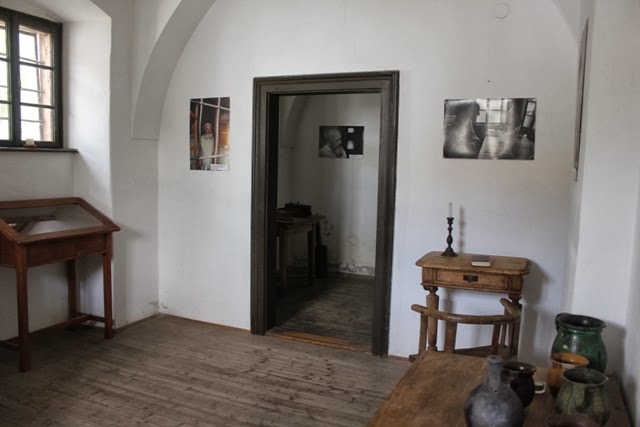
This was the inside of one of the houses, with a picture of one of the Polish monks on the wall.

I believe this is St. Romuald, the founder of the Camaldolese Order. He left the Benedictine order, because it wasn't strict enough. He was an Italian monk. The orders he established included hermits and communal monks. He lived in the 10th and 11th century. Legend says that he lived to be 120, after founding the monastery at 96, though it's believed that he died around 80.

This is a quote by Romuald, courtesy of Wikipedia, our most reliable source:


"Sit in your cell as in paradise. Put the whole world behind you and forget it. Watch your thoughts like a good fisherman watching for fish. The path you must follow is in the Psalms — never leave it.

If you have just come to the monastery, and in spite of your good will you cannot accomplish what you want, take every opportunity you can to sing the Psalms in your heart and to understand them with your mind.

And if your mind wanders as you read, do not give up; hurry back and apply your mind to the words once more.

Realize above all that you are in God's presence, and stand there with the attitude of one who stands before the emperor.

Empty yourself completely and sit waiting, content with the grace of God, like the chick who tastes nothing and eats nothing but what his mother brings him."


The room of silence. In case anyone was looking to torture me, this would be the location to do it.

You know me, I am unable to stay silent for very long.


The crafts room.


Some torture devices, otherwise known as shoes.


There was an interesting superstition about this crossroads. Supposedly, if you closed your eyes and held your hands out, you'd feel an electricity flow through you.

I did not feel any electricity.


The Church from the back.


The church from the side. The church was actually not burned when ordered to be by Joseph II, but later pulled down after the monastery was no longer in use.


The outer gates.

It was all very interesting, especially the fact that people would choose to live like that and still do to this day. I looked through a book of the monks in Poland, who as I said just recently allowed themselves to be photographed. Their life is very simple.

Also one of them looked exactly like Ben Kingsley. Unfortunately, I was unable to get a picture of the picture

After we left the monastery, we headed to the town of Tata and a Castle which is located there, but that will be for another blog.